
Inoculation (Starter %) Calculator
Find out how much starter your dough needs, what that amount does to bulk time and flavor, and how to adjust a recipe for your kitchen.
Inoculation is how much starter goes into your dough, as a percentage of the flour. 120g of starter in a dough with 500g of flour is 24% inoculation.
More starter means a faster, milder bulk. Less means a slower, tangier one. It is the easiest way to adapt a recipe to a hot kitchen, a cold one, or your schedule. It is not hydration, which is the water.
Your dough
Counts the flour and water inside the starter too (75% is the Baseline Loaf). The calculator keeps this fixed as you change the starter, so the dough feels the same.
75 to 78°F (24 to 26°C) is what recipes expect. Temperature changes bulk time more than almost anything else.
More options
100 if you feed equal weights of flour and water.
Your recipe
| Bread flour | 500g |
| Water | 360g |
| Active starter | 120g |
| Salt | 10g |
| Total dough | 990g |
Inoculation: 24% of the flour you add, or 21.4% of all the flour including the starter's.
Hydration: 72% counting only the water you add, or 75% counting the starter's too. Same dough, two honest numbers.
Inside the starter: 60g flour and 60g water.
What this means
Where the Baseline Loaf sits (24%). A good starting point for most home bakes at 75 to 78°F (24 to 26°C).
Rough bulk time (an estimate)
about 4.5 to 7.5 hours
Start checking the four signs about 3.5 hours in, then every 30 minutes. Do not wait for the timer.
The one habit that fixes the most loaves
Watch the dough, not the clock.
Every time on this page is an estimate. Your kitchen, flour and starter will not match it exactly. Bulk is done when you see all four signs together:
- Grown 50 to 75%: clearly bigger, not quite doubled
- Domed top: edges curve up where they meet the bowl
- Jiggles: wobbles like set jello when you shake the bowl
- Bubbles on the sides: a webby look through the glass
Not sure? Give it 30 more minutes and check again. A little over is easier to live with than well under.
Build the starter
The dough needs 120g of starter at its peak. Make about 150g so some is left to keep going. Pick a feed that peaks when you are ready to mix:
| Ratio | Keep starter | Add flour | Add water | Peaks in | Good for |
|---|---|---|---|---|---|
| 1:1:1 | 50g | 50g | 50g | 4-6 hr | Feed in the morning, mix after lunch |
| 1:2:2 | 30g | 60g | 60g | 6-8 hr | Feed before work, mix in the evening |
| 1:3:3 | 21g | 64g | 64g | 8-10 hr | Warm kitchens, or when it needs to wait longer |
| 1:5:5 | 14g | 68g | 68g | 10-12 hr | Feed at bedtime, mix in the morning |
Peak times assume 75 to 78°F (24 to 26°C). Use the starter when it has doubled, is domed and bubbly throughout, not when the clock says so.
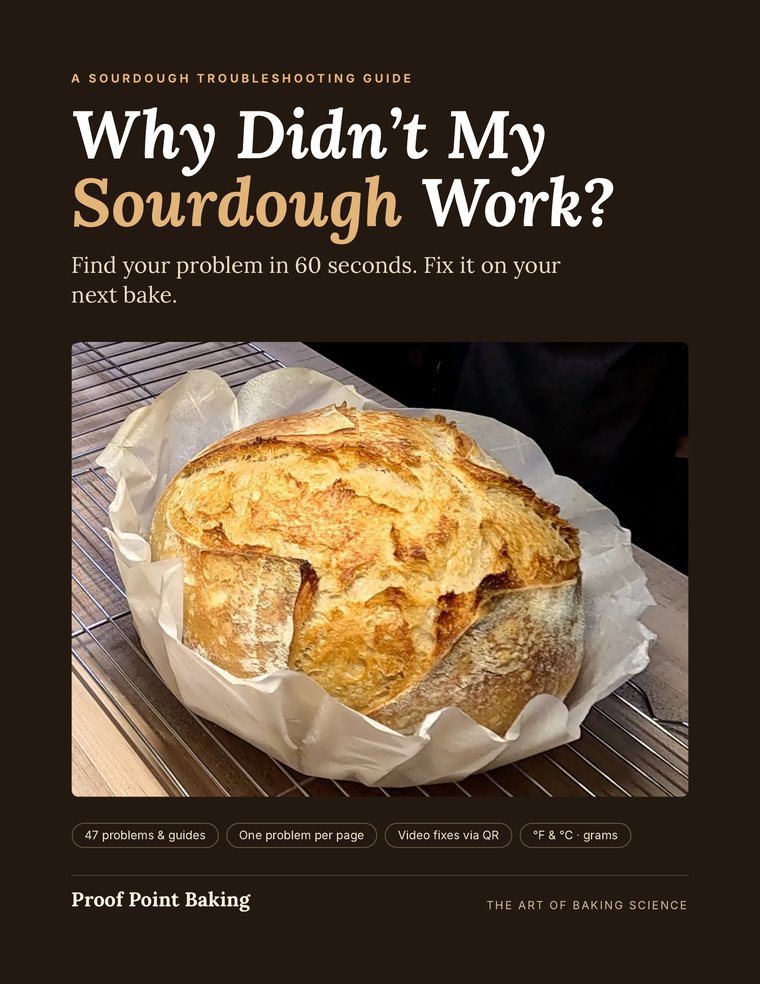
Why Didn't My Sourdough Work?
A 71-page troubleshooting guide. Find your problem in 60 seconds and fix it on your next bake.
What is inoculation?
Inoculation is the amount of starter you mix into a dough, written as a percentage of the flour. The Baseline Loaf in Why Didn't My Sourdough Work? uses 120g of starter with 500g of flour: 24% inoculation.
It is not the same as hydration. Hydration is how much water is in the dough. Inoculation is how much starter is. Changing one without the other changes how the dough behaves, which is why this calculator adjusts the water for you when you change the starter.
Starter also carries flour and water. At 100% hydration, 120g of starter is 60g of flour and 60g of water. That is why one dough can be called 72% hydration (counting only the water you add) or 75% (counting the starter's too). Both are correct; check which one a recipe uses before you change the water.
How inoculation changes your bread
More starter puts more yeast and bacteria in the dough from the start, so fermentation moves faster and there is less time for acid to build. Less starter does the opposite.
| Starter | Bulk | Flavor | Good for |
|---|---|---|---|
| About 5 to 10% | Slow | Tangier | Overnight bulk, warm kitchens |
| About 15 to 20% | Moderate | Balanced | Hot kitchens |
| About 24% | Standard | Balanced | Most bakes at 75 to 78°F (24 to 26°C) |
| About 25 to 30% | Fast | Milder | Cold kitchens |
- Too little starter and bulk drags on or the dough under-ferments. That is the most common cause of a dense, gummy loaf.
- Too much starter and the dough can race past its peak and over-ferment before the gluten and flavor have developed.
Adjusting for your kitchen
- Hot kitchen (above 80°F / 27°C): use about 15 to 20% starter instead of 24%, mix with cool water, and start checking bulk an hour or two early.
- Cold kitchen (below 70°F / 21°C): use up to 25 to 30% starter, mix with warm water, and expect bulk to take 10 to 14 hours. Do not shape early.
- Fitting your schedule: a smaller amount of starter lets you mix in the evening and bake in the morning. A larger one gets bread on the table by dinner.
- Change one thing at a time. If you change the starter, keep everything else the same for that bake, and write it down so you know what worked.
Watch the dough, not the clock.
This calculator gives you a starting point, and the times it shows are estimates built from one kitchen. Your flour, your starter and your room will move the real number, sometimes by hours. The dough is the real instruction: when it has grown 50 to 75%, has a domed top, jiggles like set jello and shows bubbles along the sides, bulk is done. Use the estimate to know when to start looking, not when to stop.
Related tools
Plan your feed with the Sourdough Starter Calculator, check your numbers with the Hydration Calculator, or look up a term in the Baking Glossary.